Devon · TQ6
Storm damage roof inspection in Dartmouth
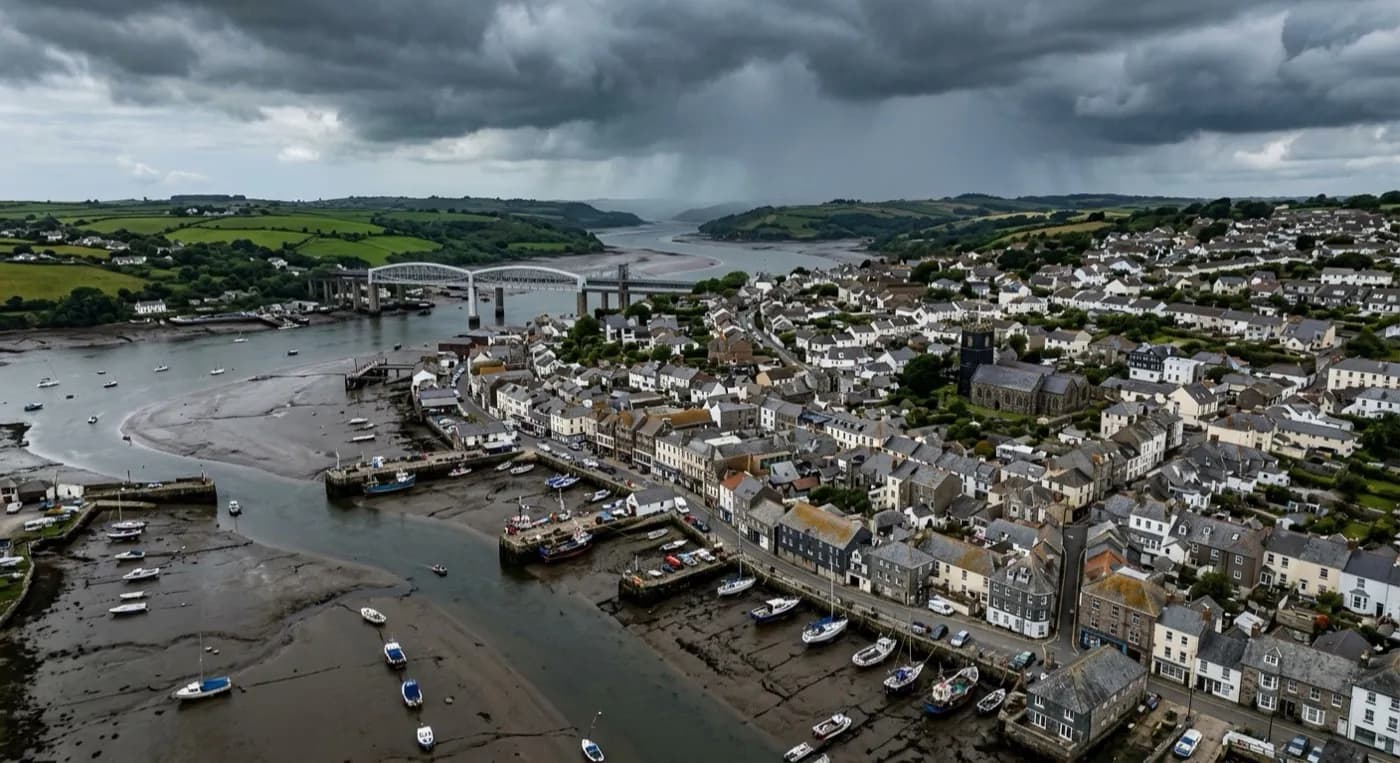
Storm damage evidence in Dartmouth, sheltered from the sea but stacked so steeply that one roof's storm water often discharges onto the one below.
Shelter from the sea, not from each other
Dartmouth is a deep-water port on the west bank of the Dart, built on ground so steep that streets become stairs, with the castle and the river mouth to the south giving real shelter from the worst of the open sea. What the town does not have is any shelter between one building and the next: the steep-stacked layout means one roof frequently discharges towards its neighbour downhill, so a storm-caused blockage or overflow on one property can send water directly at the roof or wall of the building immediately below it.
That neighbour-to-neighbour water routing is a local storm risk, distinct from a straightforward wind-driven failure, and it means damage attributed to 'my roof' after a storm sometimes actually originates on next door's.
Dartmouth Castle, at the mouth of the river below the town, sits in the most directly exposed position of any building here, a useful reference for how much shelter the steep-stacked layout gives everything built further up the hill behind it.
An exceptional stock of listed, timber-framed roofs
The timber-framed and jettied merchant houses around Bayards Cove and the Butterwalk are an exceptional survival, and their lead-lined valleys and gutters, built into complex historic roof junctions, are exactly the kind of detail a storm exploits when overloaded by water arriving from a neighbour's roof as well as its own. Georgian and Victorian terraces climbing the hill above see more straightforward slate and slate-hung storm damage, in line with the rest of this stretch of coast.
For listed buildings especially, establishing precisely where a storm-caused failure originated matters for how any repair is consented, since a conservation officer will want to know whether the fault sits on the building being repaired or on the one uphill from it.
Photographing a whole stack of roofs, not just one
Because the failure on one roof in Dartmouth can originate on the property above it, a flown survey that captures the relationship between neighbouring roofs on the hillside, not just the roof in isolation, gives a far more useful record than a single property's photographs taken alone.
Nothing about that survey touches historic fabric, which matters on Grade II buildings where any physical access is itself a conversation with the conservation officer before a single ladder goes anywhere near the roof.
The Britannia Royal Naval College dominates the skyline from its position on high ground above the town, in the same TQ6 postcode as the merchant houses down at Bayards Cove, and the difference in exposure between the two ends of that short walk is exactly the kind of variation a single ground-level description would miss. Totnes, up the Dart valley, is a considerably calmer address.
Behind the survey
What Dartmouth clients are actually buying
CAA registered
Operator ID and Flyer ID held, plus the A2 Certificate of Competency. Registration and insurance details go over with the pack as a matter of course, because most adjusters and agents need both on file before they can act on it.
100 megapixel camera
A DJI Mavic 4 Pro with a Hasselblad camera and 6K video. The resolution is what lets a single slate or a torn edge of felt be cropped into and still hold together, which matters when a photograph is the evidence.
Radiometric thermal
A DJI Mavic 2 Enterprise Advanced carrying a 640 by 512 thermal camera, used where water may already be tracking into the structure through storm damage and needs tracing rather than guessing at.
Insured with Coverdrone
Full commercial cover for the operation. A certificate is supplied with the pack without anyone having to chase for it, which is usually one of the first things a loss adjuster or managing agent asks for.
Nearby
Also covered around Dartmouth
- BrixhamStorm damage evidence in Brixham, the most exposed part of Torbay, a headland taking wind from every quarter rather than one dominant direction.
- KingsbridgeStorm damage evidence in Kingsbridge, sheltered by the estuary but where steep, packed streets create turbulence around chimneys and dormers.
- SalcombeStorm damage evidence in Salcombe, where contemporary flat-roofed second homes, often empty when a storm hits, bring risks a slate roof does not share.
Call now
Book a claim inspection in Dartmouth
Send the address and what is worrying you. Sam Hembury will come back with a fixed price and the next slot that suits the weather.